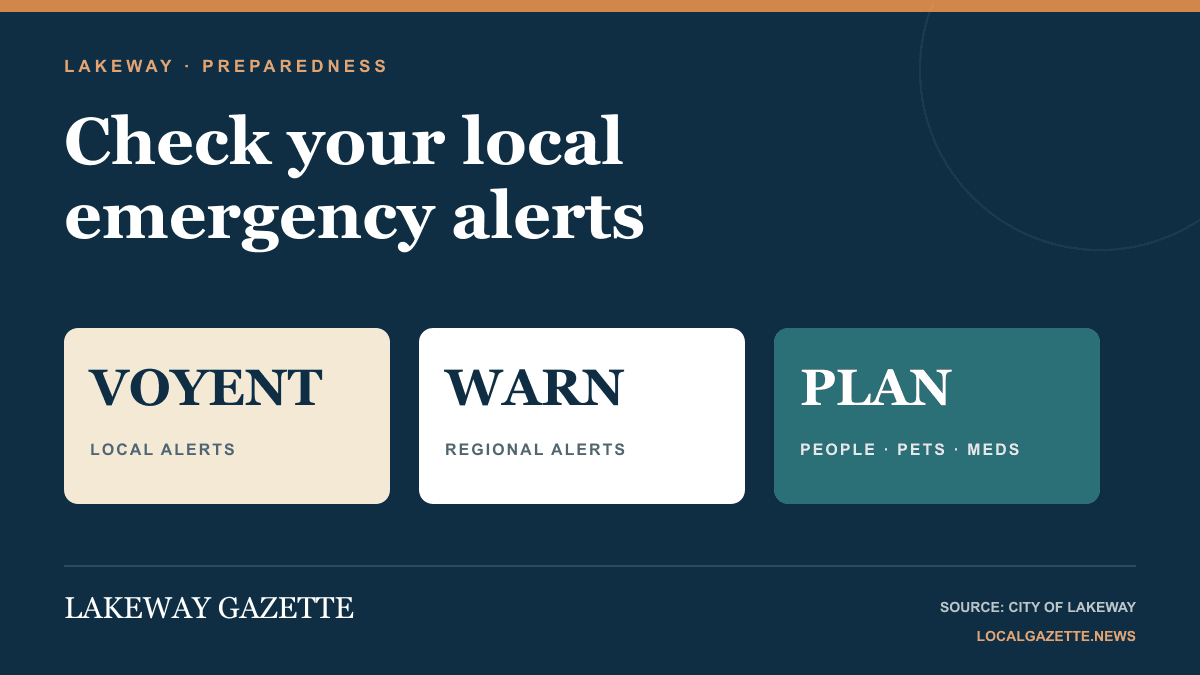
Lakeway residents are being encouraged to check their emergency-alert registrations and make sure household plans reflect medical, transport and pet needs.
The city's local system, Voyent Alert, can send app notifications, text messages, emails or landline voice calls. Warn Central Texas is the regional service, and the city recommends registering for both rather than assuming one account covers every message.
Lakeway tested its local system on September 4. Anyone who expected a test but did not receive it should check the account's contact details, notification settings and saved location.
Why two systems matter
A local service can carry city-specific information while a regional tool may cover an incident crossing municipal boundaries. Registering for both creates more than one route for warnings, although no system can guarantee delivery in every circumstance.
Residents should keep location information accurate, allow notifications on their phone and avoid relying solely on social media. A NOAA weather radio can provide another channel when internet or mobile service is unreliable.
Build a household plan
The city asks residents to consider evacuation help, especially for anyone using a wheelchair, walker or other assistive device. Medication, medical supplies, chargers and spare batteries should be included in a disaster kit.
Important insurance, identity and medical documents can be copied and stored in a waterproof container or secure digital location. Families should agree on a contact outside the immediate area and a way to reconnect if household members are separated.
A support network should know where emergency supplies are kept and, where appropriate, have access to the home. People receiving regular treatment should ask their provider about backup arrangements before an emergency.
Pets and local hazards
Not every shelter accepts animals, so a plan should identify pet-friendly alternatives, transport and supplies. Service-animal needs should also be considered explicitly.
For wildfire risk, the city advises maintaining defensible space and clearing debris from roofs and gutters. For flooding, residents should move to safety and never walk or drive through floodwater. A fire plan should include usable exits for every household member.
Preparedness advice does not mean a specific disaster is imminent. The purpose is to make decisions in advance, when residents have time to confirm information and gather supplies.
A short check today
Residents can verify phone numbers and addresses in both alert systems, choose an emergency contact, check medication dates and make sure every household member knows two exit routes. Those small actions are more useful than creating a complex plan that nobody can remember.
Keep the information current
Alert registrations are not a one-time task. Households should review them after changing a phone number, moving home, adding a dependent or altering a care arrangement. Renters, seasonal residents and people who work in Lakeway can also check whether the system allows more than one saved location.
A printed contact list remains useful if a phone is damaged or has no power. Each kit should reflect the people who will use it rather than a generic checklist: infant supplies, mobility equipment, hearing or vision aids and instructions for essential devices may be as important as food and water.
During a real incident, residents should follow the instructions in the alert and confirm updates through official city or emergency-service channels. Sharing an unverified screenshot can circulate old boundaries or directions after circumstances have changed.
Registration routes and the city's complete planning guidance are in the official Lakeway preparedness and emergency-alert notice.